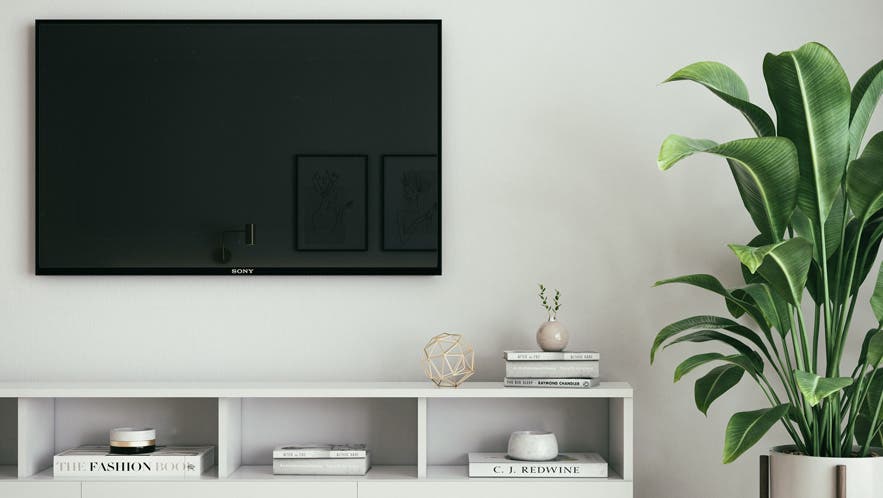
OLED and QLED are two major technologies that dominate the TV market today. These panel technologies both have their advantages, and getting to know them will be useful before you buy a new TV.
The Basics of LCD and LED Technologies
The most common display type used in consumer electronics is the LCD (liquid-crystal display) panel. It’s lit by a backlight panel consisting of white cathodes. Using a white backlight is a cost-effective way to make a display. However, it has some downsides, such as limited color gamut (aka color range) resulting in more muted pictures.
To increase the image quality, manufacturers started using RGB LEDs to backlight their LCD panels, and that’s how LED (light-emitting diode) displays were born. In a nutshell, an LED TV is basically an LCD TV with an RGB backlight that creates deeper colors.
What is QLED?
QLED stands for “quantum light-emitting diode,” and QLED technology is a major improvement in LCD technology. Unlike the liquid crystals that LCD screens have, QLED screens have special quantum dot particles that turn light into color.
In brief, a QLED TV is an LED TV with a quantum dot filter in front that provides ultra-bright picture quality and 100% color gamut. QLED TVs also perform much better than traditional LED TVs when it comes to viewing angles and black levels. With built-in anti-reflective layers inside the panel, QLED TVs produce better pictures when viewed in bright daylight.
What is OLED?
OLED stands for “organic light emitting diode” and is a relatively new technology. Like QLED, it was introduced in 2013. And as its name implies, an OLED TV has a unique panel consisting of an organic substance that glows with no need for a backlight. Each pixel emits its own light and can be controlled individually. This is the most significant feature of OLED technology.
While standard backlit panels dim the backlights to increase contrast and black levels, an OLED display can turn off individual pixels in black areas completely. That trick creates superior contrast and 100% black levels.
Should I buy a QLED TV or an OLED TV?
Picture quality and color performance
OLED and QLED are entirely different technologies. Choosing one over another isn’t difficult, and your pick depends on your situation. OLED TVs perform better in dark rooms because they can produce true blacks. Both technologies are HDR (high dynamic range) ready, but OLED is a clear winner due to its uniformity and black picture performance.
On the other hand, QLED technology outperforms OLED in terms of brightness. It can reach 2,000 nits, compared to the 1,000 nits barrier of OLED TVs. So, for the ultimate cinematic experience, an OLED TV will be the winner. If you have a very bright living room and don’t want annoying reflections on your TV screen, however, then a QLED TV will be a better option.
Both TVs perform extremely well in terms of picture quality, but since OLED TVs have a self-emissive panel, they perform much better than QLEDs when viewed from side angles. Therefore, if you have a very large living room with multiple pieces of furniture at different angles, then an OLED may be a better choice for you.
Design and aesthetics
QLED design is based on the classic LCD design, so these TVs are not as thin as OLEDs. The organic layers of an OLED TV are both thinner and lighter, with flexible structures, so they are a slimmer choice compared to QLED options.
Response time and gaming performance
If you plan to use your TV primarily for console gaming, then response time will affect your overall gaming experience. OLED offers almost 10 times faster response time compared to QLED, and for many gamers, that makes it the clear winner. Both TV types support FreeSync technology, which is great because it reduces visuals issues such as screen lag and tearing.
Samsung QLED TVs have built-in game enhancer engines, which can improve the console gaming experience. If you demand the best gaming TV on the market, then you should consider OLED as your first choice. That being said, a QLED will also offer you a great experience when playing 4K-compatible games.